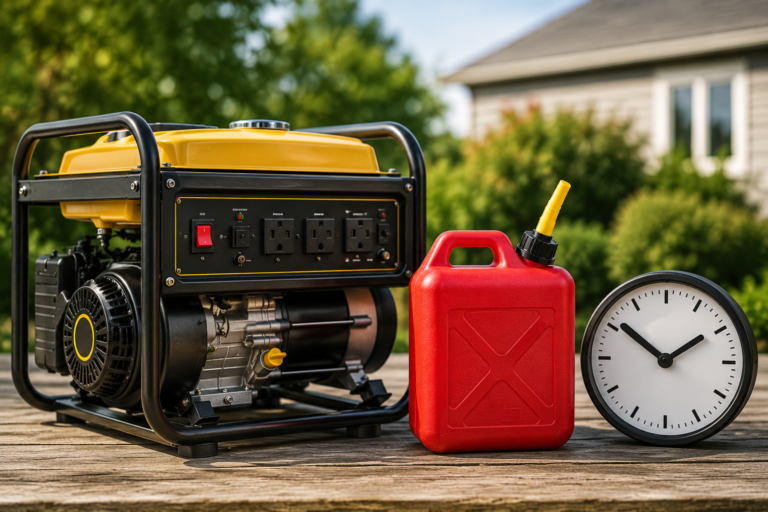
How Much Fuel Does a Generator Use Per Hour?
A generator’s fuel consumption depends on its size, fuel type, electrical load, engine efficiency, and operating conditions. There is no single fuel consumption rate that applies to every generator.
A small portable generator may use less than 1 gallon of gasoline per hour, while a larger generator operating under a heavy load can consume several gallons per hour. Diesel generators can also have substantially different consumption rates depending on their power output and load.
Knowing how much fuel your generator uses per hour is important when estimating runtime, fuel costs, and how much fuel you need during a power outage.
If you know your generator’s fuel consumption and available fuel, you can use our Generator Runtime Calculator to estimate how long the generator can operate before refueling.
What Determines Generator Fuel Consumption?
The amount of fuel a generator uses per hour is primarily affected by how much electrical power it is producing.
Several factors can affect consumption:
- Generator size and engine capacity
- Electrical load
- Fuel type
- Engine efficiency
- Generator design
- Operating conditions
- Maintenance and engine condition
A generator running at a light load generally uses less fuel per hour than the same generator operating close to its maximum rated output.
However, fuel consumption does not always increase proportionally with electrical load. Every engine has a certain amount of fuel consumption simply to keep running.
Typical Generator Fuel Consumption
Generator fuel consumption varies widely, so the figures below should be treated as general examples rather than specifications for a particular generator model.
| Generator Size | Approximate Fuel Use | Example Fuel Type |
|---|---|---|
| 2,000–3,000 watts | 0.2–0.4 gal/hour | Gasoline |
| 4,000–5,000 watts | 0.4–0.7 gal/hour | Gasoline |
| 7,000–8,000 watts | 0.6–1.0 gal/hour | Gasoline |
| 10,000–12,000 watts | 0.8–1.3 gal/hour | Gasoline |
| 15,000–20,000 watts | 1.0–2.0+ gal/hour | Gasoline/Diesel |
| Larger commercial generators | 2+ gal/hour | Diesel |
Actual consumption can be significantly different between models, even when their power ratings are similar.
For accurate planning, use the fuel consumption information supplied by the manufacturer.
How Much Gas Does a Portable Generator Use Per Hour?
Portable gasoline generators can have relatively low fuel consumption, particularly when powering smaller loads.
For example, a portable generator might consume approximately:
- 0.25 gallons per hour at a light load
- 0.5 gallons per hour at a moderate load
- 0.75 gallons per hour at a heavier load
- 1 gallon per hour or more at high output
These are examples only. Your generator’s actual consumption may be lower or higher.
A generator’s advertised runtime can also help you estimate its consumption.
For example, if a generator has a 5-gallon tank and the manufacturer states that it can run for 10 hours under specified conditions:
5 ÷ 10 = 0.5 gallons per hour
That gives an estimated consumption of 0.5 gallons per hour under those conditions.
How Much Fuel Does a 5,000-Watt Generator Use?
A 5,000-watt gasoline generator may use somewhere around 0.4 to 0.7 gallons per hour depending on the load and specific model.
For example, if the generator consumes 0.5 gallons per hour:
- 5 gallons would last approximately 10 hours
- 10 gallons would last approximately 20 hours
- 20 gallons would last approximately 40 hours
These calculations assume constant consumption and do not account for changes in electrical load.
The actual figures should come from your generator’s specifications.
How Much Fuel Does a 10,000-Watt Generator Use?
A 10,000-watt generator typically requires more fuel than a smaller portable generator, especially when operating near its rated output.
A hypothetical generator consuming 1 gallon per hour would use:
- 5 gallons in 5 hours
- 10 gallons in 10 hours
- 20 gallons in 20 hours
- 24 gallons in 24 hours
But a 10,000-watt generator operating at a light load may consume substantially less than it would at full output.
This is why generator wattage alone cannot determine fuel consumption.
Does Generator Load Affect Fuel Consumption?
Yes. Load is one of the most important factors affecting fuel consumption.
Consider a generator rated for 8,000 watts.
If it is only supplying 1,500 watts to essential appliances, the engine may consume considerably less fuel than when supplying 7,000 watts.
Your load may include equipment such as:
- Refrigerators
- Freezers
- Lights
- Fans
- Air conditioners
- Water pumps
- Computers
- Televisions
- Power tools
- Electric heaters
High-power appliances can significantly increase the generator’s workload.
For this reason, a generator that runs for a certain number of hours at 25% load may have a much shorter runtime at 75% or 100% load.
Fuel Consumption at Different Loads
Manufacturers sometimes provide fuel consumption or runtime information at different load levels.
A typical pattern might look like this:
| Load | Expected Fuel Consumption |
|---|---|
| Low load | Lowest consumption |
| Moderate load | Moderate consumption |
| High load | Higher consumption |
| Full rated load | Highest consumption |
The exact numbers depend on the generator.
When comparing two generators, don’t compare fuel consumption without considering the load at which the figures were measured.
A generator consuming 0.6 gallons per hour at 50% load cannot be directly compared with another generator consuming 0.8 gallons per hour at 75% load without accounting for the difference in operating conditions.
Gasoline vs. Diesel Generator Fuel Consumption
Gasoline and diesel generators use different engine technologies and have different fuel characteristics.
Diesel generators are commonly used for larger standby, industrial, and commercial applications. Gasoline generators are common among smaller portable units.
Fuel consumption depends on more than the fuel type, however. Generator size, engine efficiency, load, and design can have a major impact.
Instead of assuming that one fuel type always consumes less, compare the manufacturer’s fuel consumption figures for generators operating at similar power outputs and loads.
How Much Fuel Does a Diesel Generator Use Per Hour?
Diesel generator consumption can vary dramatically depending on generator size and load.
A small diesel generator may consume less than 1 gallon per hour, while larger commercial and industrial generators can consume several gallons per hour.
Manufacturers may provide fuel consumption in:
- Gallons per hour
- Liters per hour
- Liters per hour at a specific load
- Fuel consumption per kWh
If the manufacturer provides consumption at several load levels, use the figure that most closely matches your expected operating load.
How Much Fuel Does a Propane Generator Use?
Propane generators can have different fuel consumption characteristics from gasoline or diesel generators.
Consumption may be listed in:
- Gallons per hour
- Pounds per hour
- Liters per hour
Propane consumption also depends heavily on generator output and load.
If you are estimating runtime, make sure the fuel amount and consumption rate use compatible units.
How to Calculate Generator Fuel Consumption
If you know how long a generator runs and how much fuel it uses, you can calculate its approximate hourly fuel consumption.
The formula is:
Fuel Consumption Per Hour = Fuel Used ÷ Operating Time
For example, if a generator uses 6 gallons of fuel during 12 hours of operation:
6 ÷ 12 = 0.5 gallons per hour
The generator’s average consumption is 0.5 gallons per hour.
This is an average. Actual consumption may change when the electrical load changes.
How to Calculate Generator Runtime From Fuel Consumption
Once you know the hourly fuel consumption, you can estimate how long the generator will run.
The formula is:
Runtime = Available Fuel ÷ Fuel Consumption Per Hour
For example:
- Available fuel: 10 gallons
- Fuel consumption: 0.5 gallons per hour
10 ÷ 0.5 = 20 hours
The estimated runtime is 20 hours.
You can calculate this manually or use our Generator Runtime Calculator.
How Much Fuel Does a Generator Use in 24 Hours?
To estimate 24-hour fuel consumption, multiply the hourly consumption by 24.
Fuel Required = Fuel Consumption Per Hour × 24
For example, a generator consuming 0.75 gallons per hour would use:
0.75 × 24 = 18 gallons
So the estimated fuel requirement would be 18 gallons for 24 hours under a constant 0.75 gallons-per-hour consumption rate.
If the load changes throughout the day, actual consumption will also change.
How Much Fuel Does a Generator Use Overnight?
Suppose you want to run your generator for 10 hours overnight and it consumes 0.6 gallons per hour.
The calculation is:
0.6 × 10 = 6 gallons
You would need approximately 6 gallons of fuel for that operating period under the assumed consumption rate.
If you are powering different appliances throughout the night, your actual consumption may vary.
How Does Generator Size Affect Fuel Consumption?
Larger generators generally have larger engines and can produce more electrical power, which often means higher fuel consumption when operating under comparable conditions.
However, choosing a larger generator than you need can also be inefficient if it spends most of its time operating at a very light load.
For backup power, choose a generator that can safely handle the electrical load you actually need rather than selecting one based solely on maximum wattage.
How Can You Reduce Generator Fuel Consumption?
You can potentially reduce fuel consumption by managing the electrical load and keeping the generator properly maintained.
Consider:
Run Only Necessary Equipment
During an outage, avoid powering appliances and equipment that you don’t actually need.
Avoid Unnecessary High Loads
Large electric heaters, air conditioners, pumps, and other high-wattage appliances can substantially increase generator demand.
Maintain the Generator
Follow the manufacturer’s maintenance schedule. Proper maintenance helps the engine operate as designed.
Use Manufacturer Load Information
If the manufacturer provides consumption figures for different loads, use the figure that best matches your expected operating conditions.
Don’t Oversize the Generator Without a Reason
A much larger generator isn’t automatically better. It may consume more fuel and cost more to operate if your normal load is relatively small.
How Accurate Are Generator Fuel Consumption Ratings?
Manufacturer fuel consumption figures are useful, but they are usually measured under defined test conditions.
Your actual fuel consumption may differ because of:
- Electrical load
- Ambient temperature
- Altitude
- Fuel quality
- Generator age
- Maintenance condition
- Engine efficiency
- Operating conditions
For this reason, treat calculated fuel consumption and runtime as estimates.
How Much Fuel Should You Keep for a Power Outage?
The amount of fuel you need depends on:
- Generator fuel consumption
- Expected operating hours
- Electrical load
- Available fuel storage
- Local safety requirements
If your generator consumes 0.75 gallons per hour and you expect to run it for 12 hours:
0.75 × 12 = 9 gallons
You would need approximately 9 gallons under those assumptions.
For emergency planning, don’t rely on a calculation that leaves you with exactly enough fuel. Allow an appropriate reserve and follow local regulations and the generator manufacturer’s instructions for fuel storage.
Frequently Asked Questions
How much fuel does a generator use per hour?
It depends on the generator and its load. Small portable generators may use a fraction of a gallon per hour, while larger generators can consume several gallons per hour.
Does a generator use more fuel at full load?
Generally, yes. A generator operating at or near its rated output typically consumes more fuel per hour than it does under a lighter load.
How much gas does a 5,000-watt generator use per hour?
A 5,000-watt gasoline generator may consume roughly 0.4 to 0.7 gallons per hour under various operating conditions, but the actual figure depends on the specific model and load.
How much fuel does a 10,000-watt generator use per hour?
It varies by model and load. A 10,000-watt generator can consume around 1 gallon per hour or more under certain operating conditions, but manufacturer specifications should be used for an accurate estimate.
How do I calculate fuel consumption per hour?
Divide the amount of fuel used by the number of hours the generator operated:
Fuel Consumption Per Hour = Fuel Used ÷ Operating Time
How do I calculate how long my fuel will last?
Divide the available fuel by the generator’s hourly consumption:
Runtime = Available Fuel ÷ Fuel Consumption Per Hour
You can use the Generator Runtime Calculator to make this calculation quickly.
Does generator size determine fuel consumption?
Generator size influences fuel consumption, but it is not the only factor. Load, engine design, efficiency, fuel type, and operating conditions also matter.
Is diesel more fuel efficient than gasoline?
Diesel engines can be more fuel-efficient in many applications, particularly at larger power outputs, but you should compare actual manufacturer consumption figures rather than assuming one fuel type will always use less fuel.
Conclusion
There is no universal answer to how much fuel a generator uses per hour. Fuel consumption depends on generator size, electrical load, fuel type, engine efficiency, and operating conditions.
The best source for your generator’s consumption rate is its manufacturer’s documentation.
Once you know the hourly fuel consumption and the amount of fuel available, calculating runtime is simple:
Generator Runtime = Available Fuel ÷ Fuel Consumption Per Hour
For a quick estimate, use the Generator Runtime Calculator to determine how long your available fuel may last.