Inverter vs Conventional Generators: Which Should You Buy?
The biggest choice when you buy a portable generator is not the brand. It is whether to get an inverter generator or a conventional one. They differ in weight, noise, price per watt and how clean the power is. This guide uses figures from the manufacturers’ own pages, taken from our generator comparison tool, so you can see the gap on real models.
The short answer
Choose an inverter if you power laptops, phones, a television or an RV, if noise matters, or if you carry the unit around. Choose a conventional generator if you run power tools, want the most watts for the money, or plan a home backup wired through a transfer switch.
How the two types differ
A conventional generator runs its engine at a fixed speed so the output stays at 60 Hz. An inverter generator makes alternating current, converts it to direct current, then electronically converts it back to clean 120 V. Because the engine does not have to hold one speed, an inverter can slow down at light load. That is why inverter models tend to be quieter and lighter, and why they cost more.
Power quality: total harmonic distortion
Total harmonic distortion (THD) measures how far the output is from a clean sine wave. Electronics prefer a low number. In our comparison, the Champion 100809 states under 3% THD and the Westinghouse iGen5000DF states 3% or less. The conventional Westinghouse WGen3600DF states up to 23%. That is fine for lights, heaters and most motors, but it is a poor match for laptops and other sensitive electronics unless you add a power conditioner.
Weight and noise on real models
| Model | Type | Running watts | Weight | Noise as stated |
|---|---|---|---|---|
| Champion 100809 | Inverter | 3,000 | 48.1 lb | 64 dBA at 23 ft |
| Westinghouse iGen5000DF | Inverter | 3,900 | 104.7 lb | 52 dBA |
| Westinghouse WGen3600DF | Conventional | 3,600 | 120 lb | 68 dBA |
| Honda EU7000iS | Inverter | 5,500 | 263.2 lb | 58 dB at rated load |
| Westinghouse WGen9500DF | Conventional | 9,500 | 211 lb | 74 dBA |
Makers measure noise differently, some at a set distance and some at the generator, so compare within one maker’s range. The pattern still holds: the iGen5000DF is stated at 16 dBA below the WGen3600DF, and the Champion inverter weighs less than half as much as the Westinghouse conventional unit while offering 600 fewer running watts. Weight is not always lower, though. The Honda EU7000iS is the heaviest unit in our comparison at 263.2 lb, more than the 9,500 W conventional WGen9500DF.
Price per running watt
This is where conventional generators win. Among the models with a published price, the WGen3600DF at 629 USD works out to about 0.17 USD per running watt. The iGen5000DF at 1,199 USD is about 0.31 USD per running watt, and the Predator 3500 inverter at 799.99 USD is about 0.27 USD. The big conventional units are cheaper still: the WGen9500DF is about 0.13 USD and the DuroMax XP13000EH about 0.12 USD. These are our own divisions of listed prices on 2 November 2026, and prices change.
Fuel use
Inverters can throttle down at low load, which can save fuel. Our data does not show a clear winner, because makers state runtime at different loads. The derived figures on the comparison page range from about 0.19 to 0.32 gallons of gasoline per kWh across both types. If running cost matters, compare the fuel table and your own typical load rather than assuming either type is cheaper.
Which should you buy?
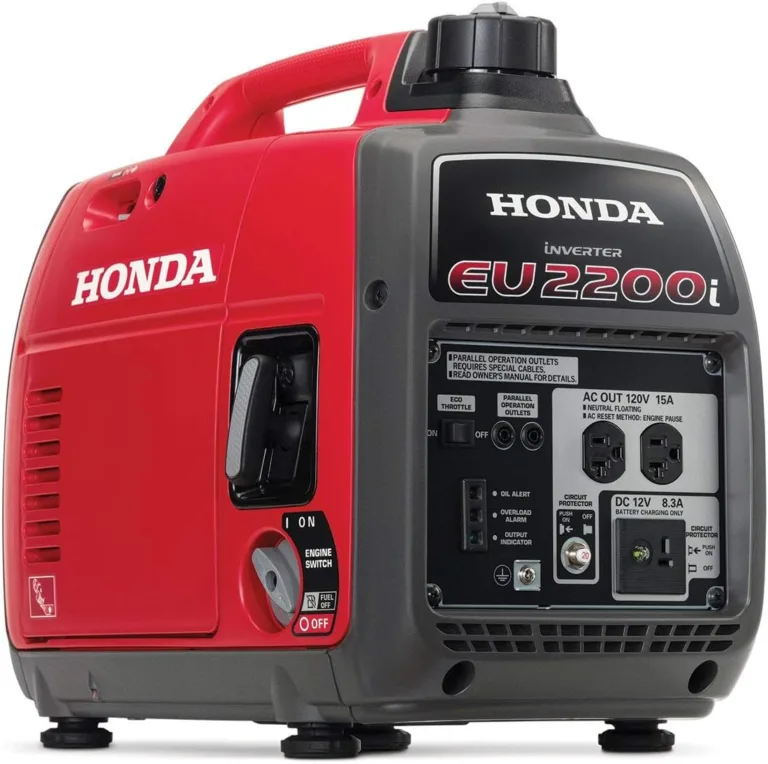
- Camping, tailgating, small devices: an inverter such as the Honda EU2200i or Champion 100809.
- RV: an inverter with a 30 A outlet, such as the iGen5000DF.
- Power tools and jobsites: a conventional unit such as the WGen3600DF.
- Whole-circuit home backup: a large conventional unit such as the WGen9500DF or XP13000EH, or a quiet 5,500 W inverter if budget and weight allow.
Size the load first with the load calculator, then use the comparison tool to line up your shortlist.
Frequently asked questions
Can I run a laptop on a conventional generator?
Often yes, but distortion matters. A unit that states up to 23% THD is a risk for sensitive electronics. See running electronics on a generator for ways to protect them.
Are inverter generators always quieter?
They tend to be, mostly at light load. Noise is measured differently by each maker, so compare the stated conditions as well as the number.
Can I connect two inverter generators?
Some can be run in parallel, often with a separate kit. In our comparison the Champion 100809, Honda EU2200i, Generac GP3500iO, Yamaha EF2200iS and Westinghouse iGen5000DF are listed as parallel capable.
Which type is better for home backup?
Large conventional units give more watts for the money. Inverters are quieter. Either needs a proper transfer switch. Read how to connect a generator safely first.