Yamaha Generators: EF2200iS, EF3000iS and EF4500iSE Compared
Yamaha sells inverter generators from the compact EF2200iS to the EF4500iSE, and a large open-frame model, the EF7200DE. This guide lists the Yamaha models we could verify against Yamaha’s own specification pages, retrieved on 5 November 2026, and says plainly which we could not.
Models verified from Yamaha’s specification pages
| Specification | YamahaEF2200iSInverter | YamahaEF3000iS / EF3000iSEBInverter | YamahaEF4500iSEInverter |
|---|---|---|---|
| Price and ownership cost | |||
| Listed price (USD, estimate) | Not publishedYamaha's spec page does not state a price | Not publishedYamaha does not state a price on the specification page | Not publishedYamaha does not state a price on the specification page |
| Price per rated watt (derived) | n/a | n/a | n/a |
| Warranty | 3 years limited | 3 years limited | 3 years limited |
| Maintenance | Not stated | Not stated | Not stated |
| Oil capacity | Not stated | Not stated | Not stated |
| Power | |||
| Rated output by fuel |
|
|
|
| Starting or surge watts | 2,200 W | 3,000 W | 4,500 W |
| Fuel types | Gasoline | Gasoline | Gasoline |
| Engine | Not stated | Not stated | Not stated |
| Displacement (cc) | 79 cc | 171 cc | 357 cc |
| Runtime, fuel use and running cost | |||
| Fuel tank (gal) | 1.24 gal | 3.4 gal | 4.5 gal |
| Runtime on a tank, as stated |
|
|
|
| Fuel use, as stated | Not stated | Not stated | Not stated |
| Fuel per kWh (derived) | 0.262 galgasoline at 25% load, from tank size and stated runtime | 0.261 galgasoline at 25% load, from tank size and stated runtime | 0.296 galgasoline at 25% load, from tank size and stated runtime |
| Fuel cost per kWh at your price (derived) | |||
| Fuel cost per hour at that load (derived) | |||
| Size and comfort | |||
| Weight (lb) | 55.2 lb | 156 lb | 209 lb |
| Dimensions | Not stated | Not stated | Not stated |
| Noise (as stated) | 57 to 65 dBA (Yamaha lists a range) | 54.5 dBA from 1/4 load to rated load (no measurement distance stated) | 58 to 60 dBA from 1/4 load to rated load (no measurement distance stated) |
| Starting method | Not stated | Not stated | Not stated |
| Features | |||
| Inverter output | Yes | Yes | Yes |
| Total harmonic distortion | Not stated | Not stated | Not stated |
| Automatic voltage regulation (AVR) | Not stated | Not stated | Not stated |
| CO sensor shutdown | Yes | Not stated | Not stated |
| Transfer switch ready | Not stated | Not stated | Not stated |
| Parallel capable | Yes | Not stated | Not stated |
| Outlets and connections | 12V DC, 3 A | Not stated on the page; 12 V DC at 12 A | Not stated on the page |
| Fit | |||
| Suited to | Camping and outdoors, RV and travel trailer | Camping and outdoors, RV and travel trailer, Essential circuits | RV and travel trailer, Essential circuits, Emergency backup |
| Also worth knowing | CO sensor shutdown, parallel operation with a second unit | Two variants: iS at 136 lb and iSEB at 156 lb; the 156 lb weight shown is the iSEB | Brushless inverter; 209 lb dry weight; start method and outlets not listed on the page |
| Honest take | |||
| Advantages |
|
|
|
| Drawbacks |
|
|
|
| Source | |||
| Where the figures come from | Yamaha Motor Corporation USA specifications (2021 model page)Retrieved 2026-11-02 | Yamaha specification pageRetrieved 2026-11-04 | Yamaha specification pageRetrieved 2026-11-05 |
- EF2200iS: 1,800 running and 2,200 peak watts, 55.2 lb, 57 to 65 dBA and 10.5 hours at 1/4 load. Yamaha lists a CO sensor shutdown.
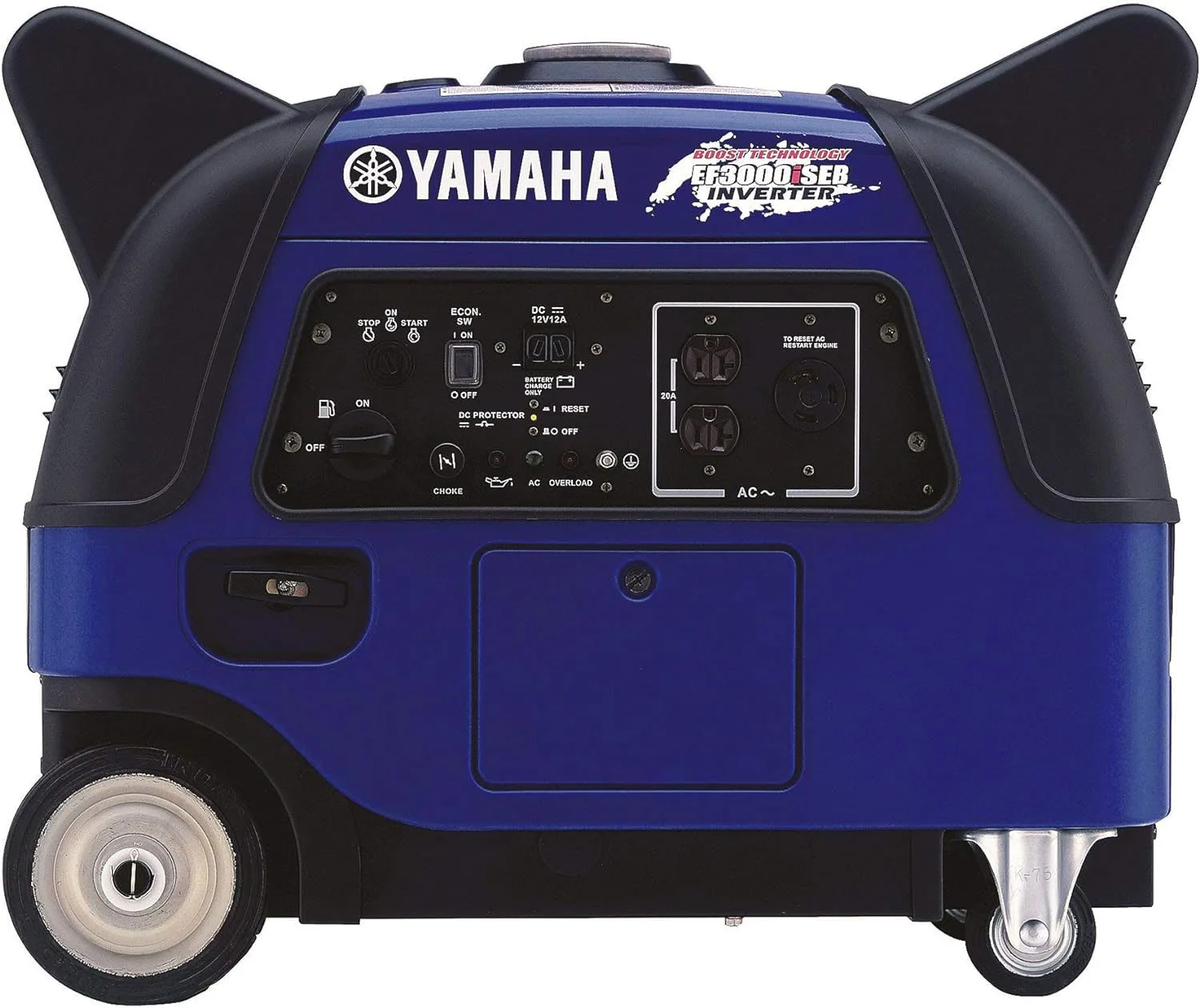
- EF3000iS / EF3000iSEB: 2,800 running and 3,000 peak watts, 54.5 dBA from 1/4 load to rated load, 18.6 hours at 1/4 load, and 136 lb (iS) or 156 lb (iSEB).
- EF4500iSE: 4,000 running and 4,500 peak watts, a 357cc engine, 4.5 gal tank, 15.2 hours at 1/4 load, 58 to 60 dBA and 209 lb dry weight.
All three carry a 3 year limited warranty. Yamaha states no price, start method or measurement distance for the noise figures on these pages, so the tool shows “Not stated”.
Models we could not verify
- EF7200DE. Yamaha’s specification page for this model returned a server error when we tried, so it is not in our database. Retailers list it at 6,000 running and 7,200 starting watts with electric start, but they disagree on noise (from 60 to 80 dBA, with different measuring conditions) and weight (234 to 287 lb), so we give no figures for them.
- ACCGNWHL24. This is a wheel accessory, not a generator, and we have not verified it.
Choosing between them
| If you want | Look at |
|---|---|
| The lightest Yamaha | EF2200iS (55.2 lb) |
| The longest stated run time at 1/4 load | EF3000iS (18.6 hours) |
| The most output | EF4500iSE (4,000 running watts), at 209 lb |
Choose the size first with the size calculator and the load calculator, then check fuel use with the fuel consumption calculator. For a side-by-side with Honda, see the Honda vs Yamaha guide.
What we could not verify
- Prices. Yamaha states none on these pages.
- Reliability and service cost. We have no data for any brand.
- Noise distances. Yamaha gives dBA ranges without a distance, so the figures cannot be ranked against makers who state one.
Related guides
Frequently asked questions
Which Yamaha generator is the quietest?
On Yamaha’s stated figures the EF3000iS lists 54.5 dBA, the EF4500iSE 58 to 60 dBA and the EF2200iS 57 to 65 dBA. No distance is stated, so treat the differences as small.
How big is the EF4500iSE?
Yamaha lists 30.7 in by 24.3 in by 27.2 in and 209 lb dry weight.
Does Yamaha state prices?
Not on the specification pages we used, so we show none.