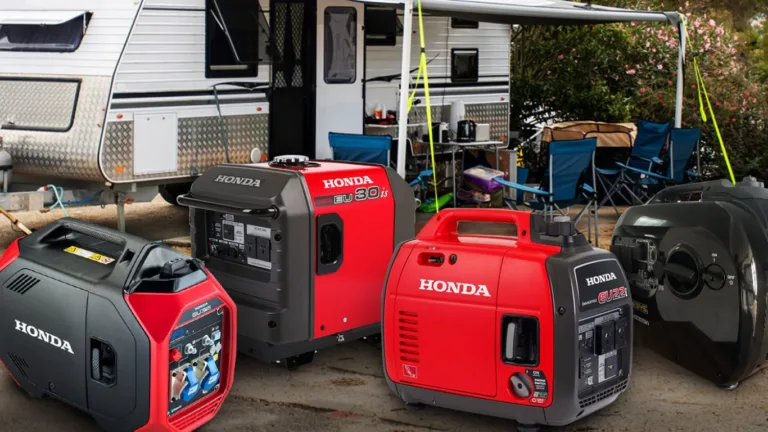
Camping Generators: Verified Models by Size and Fuel
A camping generator has to be light enough to lift into the car, quiet enough for a campground and big enough for what you plug in. This guide sorts the models in our comparison tool into those groups, using the figures each maker publishes, and says where a figure is missing. Specifications were retrieved from manufacturer pages and manuals between 2 and 5 November 2026.
Start with what you will plug in
List the devices, add their running watts, and leave room for any that surge at start-up. The appliance wattage chart, size calculator and load calculator do the sums. Running watts are the figure to size against. Peak watts are a short surge rating.
Small inverter generators: phones, laptops, lights, a fan
| Specification | HondaEU2200iInverter | YamahaEF2200iSInverter | WestinghouseiGen2800 (listed at the iGen2500 address)Inverter |
|---|---|---|---|
| Price and ownership cost | |||
| Listed price (USD, estimate) | Not publishedHonda's spec release does not state a price | Not publishedYamaha's spec page does not state a price | $529.00Westinghouse MSRP |
| Price per rated watt (derived) | n/a | n/a | $0.24per watt, first fuel listed |
| Warranty | 3 years residential, 3 years commercial | 3 years limited | 3 years residential, 1 year commercial |
| Maintenance | Not stated | Not stated | Not stated |
| Oil capacity | Not stated | Not stated | Not stated |
| Power | |||
| Rated output by fuel |
|
|
|
| Starting or surge watts | 2,200 W | 2,200 W | 2,800 W |
| Fuel types | Gasoline | Gasoline | Gasoline |
| Engine | Not stated | Not stated | Not stated |
| Displacement (cc) | 121 cc | 79 cc | 98 cc |
| Runtime, fuel use and running cost | |||
| Fuel tank (gal) | 0.95 gal | 1.24 gal | 0.98 gal |
| Runtime on a tank, as stated |
|
|
|
| Fuel use, as stated | Not stated | Not stated | Not stated |
| Fuel per kWh (derived) | 0.26 galgasoline at 25% load, from tank size and stated runtime | 0.262 galgasoline at 25% load, from tank size and stated runtime | 0.149 galgasoline at 25% load, from tank size and stated runtime |
| Fuel cost per kWh at your price (derived) | |||
| Fuel cost per hour at that load (derived) | |||
| Size and comfort | |||
| Weight (lb) | 46.5 lb | 55.2 lb | 46.3 lb |
| Dimensions | Not stated | Not stated | Not stated |
| Noise (as stated) | 62 dB rated load, 53 dB at 1/4 load | 57 to 65 dBA (Yamaha lists a range) | 52 dBA |
| Starting method | Recoil | Not stated | Recoil |
| Features | |||
| Inverter output | Yes | Yes | Yes |
| Total harmonic distortion | Not stated | Not stated | ≤3% |
| Automatic voltage regulation (AVR) | Not stated | Not stated | Not stated |
| CO sensor shutdown | Not stated | Yes | No |
| Transfer switch ready | Not stated | Not stated | No |
| Parallel capable | Yes | Yes | Not stated |
| Outlets and connections | One 20A 120V duplex, 12V 100W DC | 12V DC, 3 A | 5-20R duplex, two USB |
| Fit | |||
| Suited to | Camping and outdoors, RV and travel trailer | Camping and outdoors, RV and travel trailer | Camping and outdoors, RV and travel trailer, Tailgating |
| Also worth knowing | Eco Throttle, oil alert, fuel shut-off valve | CO sensor shutdown, parallel operation with a second unit | Two USB ports; no CO sensor |
| Honest take | |||
| Advantages |
|
|
|
| Drawbacks |
|
|
|
| Source | |||
| Where the figures come from | Honda Power Equipment technical specificationsRetrieved 2026-11-02 | Yamaha Motor Corporation USA specifications (2021 model page)Retrieved 2026-11-02 | Westinghouse product page (the iGen2500 address now shows the iGen2800)Retrieved 2026-11-04 |
- Weight is the gap. The Honda EU2200i is 46.5 lb and the Westinghouse iGen2800 is 46.3 lb. The Yamaha EF2200iS is 55.2 lb.
- Run time is stated at 1/4 load. That is 8.1 hours for the Honda, 10.5 for the Yamaha and 12 for the Westinghouse. The Honda runs 3.2 hours at its full 1,800 W, and Honda is the only one of the three that publishes a full-load figure.
- Price. Westinghouse states 529 USD for the iGen2800. Honda and Yamaha state none on the pages we used.
Mid-size generators: an RV, a small air conditioner, cooking appliances
| Specification | Champion100809 4000W InverterInverter | Champion201050 4000W Dual Fuel InverterInverter | YamahaEF3000iS / EF3000iSEBInverter | WestinghouseiGen5000DFInverter |
|---|---|---|---|---|
| Price and ownership cost | ||||
| Listed price (USD, estimate) | Not publishedChampion's product page does not state a price | Not publishedChampion's product page does not state a price | Not publishedYamaha does not state a price on the specification page | $1,199.00Westinghouse MSRP |
| Price per rated watt (derived) | n/a | n/a | n/a | $0.31per watt, first fuel listed |
| Warranty | 3 years limited, free lifetime technical support | not stated on the page reviewed | 3 years limited | 3 years residential, 1 year commercial |
| Maintenance | Not stated | Not stated | Not stated | Not stated |
| Oil capacity | Not stated | Not stated | Not stated | Not stated |
| Power | ||||
| Rated output by fuel |
|
|
|
|
| Starting or surge watts | 4,000 W | 4,000 W | 3,000 W | 5,000 W |
| Fuel types | Gasoline | Gasoline / Propane | Gasoline | Gasoline / Propane |
| Engine | Not stated | Not stated | Not stated | Not stated |
| Displacement (cc) | 149 cc | 149 cc | 171 cc | 224 cc |
| Runtime, fuel use and running cost | ||||
| Fuel tank (gal) | 1.54 gal | 1.54 gal | 3.4 gal | 3.4 gal |
| Runtime on a tank, as stated |
|
|
|
|
| Fuel use, as stated | Not stated | Not stated | Not stated | Not stated |
| Fuel per kWh (derived) | 0.205 galgasoline at 25% load, from tank size and stated runtime | 0.205 galgasoline at 25% load, from tank size and stated runtime | 0.261 galgasoline at 25% load, from tank size and stated runtime | 0.194 galgasoline at 25% load, from tank size and stated runtime |
| Fuel cost per kWh at your price (derived) | ||||
| Fuel cost per hour at that load (derived) | ||||
| Size and comfort | ||||
| Weight (lb) | 48.1 lb | 51.8 lb | 156 lb | 104.7 lb |
| Dimensions | Not stated | Not stated | Not stated | Not stated |
| Noise (as stated) | 64 dBA at 23 ft | 64 dBA at 23 ft | 54.5 dBA from 1/4 load to rated load (no measurement distance stated) | 52 dBA |
| Starting method | Recoil | Recoil | Not stated | Electric, Remote, Recoil |
| Features | ||||
| Inverter output | Yes | Yes | Yes | Yes |
| Total harmonic distortion | under 3% | Not stated | Not stated | 3% or less |
| Automatic voltage regulation (AVR) | Not stated | Not stated | Not stated | Not stated |
| CO sensor shutdown | Yes | Not stated | Not stated | No |
| Transfer switch ready | No | Not stated | Not stated | No |
| Parallel capable | Yes | Not stated | Not stated | Yes |
| Outlets and connections | 5-20R duplex, TT-30R (25 A), 12V DC, parallel outlets | 5-20R duplex, TT-30R (25 A), 12V DC | Not stated on the page; 12 V DC at 12 A | 5-20R duplex, two USB, TT-30R |
| Fit | ||||
| Suited to | Camping and outdoors, RV and travel trailer, Tailgating | Camping and outdoors, RV and travel trailer, Essential circuits | Camping and outdoors, RV and travel trailer, Essential circuits | Camping and outdoors, RV and travel trailer, Essential circuits |
| Also worth knowing | CO Shield automatic shutdown, parallel kit sold separately | Runs on gasoline or propane | Two variants: iS at 136 lb and iSEB at 156 lb; the 156 lb weight shown is the iSEB | Inverter output, key fob start |
| Honest take | ||||
| Advantages |
|
|
|
|
| Drawbacks |
|
|
|
|
| Source | ||||
| Where the figures come from | Champion Power Equipment product pageRetrieved 2026-11-02 | Champion Power Equipment product pageRetrieved 2026-11-02 | Yamaha specification pageRetrieved 2026-11-04 | Westinghouse product page (address still shows the earlier iGen4500DF name; page lists the iGen5000DF)Retrieved 2026-11-02 |
- Champion 100809. 3,000 running watts at 48.1 lb. It has a TT-30R RV outlet and CO Shield shutdown, but Champion says it is not recommended for emergency home backup, and it has recoil start only.
- Champion 201050. The dual fuel version of that class, at 51.8 lb.
- Yamaha EF3000iS. 2,800 running watts, 54.5 dBA and 18.6 hours at 1/4 load. The weight is 136 lb for the iS and 156 lb for the iSEB, so check which one you are buying. No price is stated.
- Westinghouse iGen5000DF. 3,900 running watts on gasoline, 52 dBA, remote and electric start, at 104.7 lb and 1,199 USD. It lists no CO sensor.
An air conditioner is the usual limit. Check the unit’s starting watts before you rely on any of these. Our quiet camping guide compares noise in more detail.
Dual fuel: propane for the campsite
| Specification | Champion201278 4500W Electric Start Dual Fuel InverterInverter | Champion201321 4500W Dual Fuel Open Frame InverterInverter | WestinghouseWGen3600DFPortable |
|---|---|---|---|
| Price and ownership cost | |||
| Listed price (USD, estimate) | Not publishedChampion's product page does not state a price | Not publishedChampion's product page does not state a price | $629.00Westinghouse MSRP |
| Price per rated watt (derived) | n/a | n/a | $0.17per watt, first fuel listed |
| Warranty | 3 years limited, free lifetime technical support | 3 years limited, free lifetime technical support | 3 years residential, 1 year commercial |
| Maintenance | Not stated | Not stated | Not stated |
| Oil capacity | Not stated | Not stated | Not stated |
| Power | |||
| Rated output by fuel |
|
|
|
| Starting or surge watts | 4,500 W | 4,500 W | 4,650 W |
| Fuel types | Gasoline / Propane | Gasoline / Propane | Gasoline / Propane |
| Engine | Not stated | Not stated | Not stated |
| Displacement (cc) | 212 cc | 224 cc | 212 cc |
| Runtime, fuel use and running cost | |||
| Fuel tank (gal) | 2.3 gal | 4.02 gal | 4 gal |
| Runtime on a tank, as stated |
|
|
|
| Fuel use, as stated | Not stated | Not stated | Not stated |
| Fuel per kWh (derived) | 0.187 galgasoline at 25% load, from tank size and stated runtime | 0.201 galgasoline at 25% load, from tank size and stated runtime | 0.212 galgasoline at 50% load, from tank size and stated runtime |
| Fuel cost per kWh at your price (derived) | |||
| Fuel cost per hour at that load (derived) | |||
| Size and comfort | |||
| Weight (lb) | 99.2 lb | 92.6 lb | 120 lb |
| Dimensions | Not stated | Not stated | Not stated |
| Noise (as stated) | 61 dB(A) at 23 ft | 64 dB(A) | 68 dBA |
| Starting method | Electric, Recoil | Electric | Electric, Remote, Recoil |
| Features | |||
| Inverter output | Yes | Yes | No |
| Total harmonic distortion | under 3% | Not stated | 23% or less |
| Automatic voltage regulation (AVR) | Not stated | Not stated | Not stated |
| CO sensor shutdown | Not stated | Not stated | No |
| Transfer switch ready | Not stated | Not stated | No |
| Parallel capable | Yes | Yes | No |
| Outlets and connections | 5-20R duplex, TT-30R, two USB, parallel port | TT-30R RV, 5-20R duplex, 12V 8A DC, parallel ports | 5-20R duplex, L5-30R, TT-30R |
| Fit | |||
| Suited to | Camping and outdoors, RV and travel trailer, Essential circuits | Camping and outdoors, RV and travel trailer, Essential circuits | Essential circuits, Construction and jobsite, Camping and outdoors |
| Also worth knowing | Dual fuel; two USB ports; parallel port | Open frame design; battery included for electric start; parallel ports | Key fob start, 30A breaker |
| Honest take | |||
| Advantages |
|
|
|
| Drawbacks |
|
|
|
| Source | |||
| Where the figures come from | Champion Power Equipment product pageRetrieved 2026-11-04 | Champion Power Equipment product pageRetrieved 2026-11-04 | Westinghouse product pageRetrieved 2026-11-02 |
A dual fuel generator runs on gasoline or propane, so a 20 lb cylinder can stand in for a fuel can. Propane output is lower than gasoline output on every model we list, so size against the propane figure if you plan to use it. These are heavier than the inverters above: 92.6 to 120 lb. See the propane guide and the dual fuel RV guide for run times and cautions.
Battery power stations: no engine, no exhaust
| Specification | EcoFlowDELTA 2 Portable Power StationPower stations and solar generators |
|---|---|
| Price and ownership cost | |
| Listed price (USD, estimate) | Not publishedEcoFlow’s US page shows no price |
| Price per rated watt (derived) | n/a |
| Warranty | 5 years (US product page) |
| Power | |
| Rated output by fuel |
|
| Starting or surge watts | 2,700 W |
| Fuel types | Battery (LiFePO4) |
| Battery capacity (Wh) | 1,024 Wh |
| Battery type | LiFePO4 (LFP), 51.2 V |
| Solar input (W) | 500 W max |
| AC recharge | 1,200 W max (X-Stream fast charging) |
| Cycle life | 3,000 cycles to 80% capacity |
| Outage switchover | Switches to battery within 30 ms (EPS function, not a 0 ms UPS) |
| Size and comfort | |
| Weight (lb) | 27 lb |
| Dimensions | 15.7 x 8.3 x 11.1 in (400 x 211 x 281 mm) |
| Noise (as stated) | Not stated |
| Starting method | Push-button |
| Features | |
| Inverter output | Yes |
| Total harmonic distortion | Not stated |
| Automatic voltage regulation (AVR) | Not stated |
| CO sensor shutdown | No |
| Transfer switch ready | No |
| Parallel capable | No |
| Outlets and connections | 6 AC (1,800 W total), 2 USB-A, 2 USB-A fast charge, 2 USB-C (100 W each), car outlet, 2 DC5521 |
| Fit | |
| Suited to | Camping and outdoors, RV and travel trailer, Essential circuits, Emergency backup |
| Also worth knowing | Expandable with extra batteries (up to 3 kWh per the US page); X-Boost to 2,200 W for resistive loads; no fuel, fumes or engine noise |
| Honest take | |
| Advantages |
|
| Drawbacks |
|
| Source | |
| Where the figures come from | EcoFlow DELTA 2 user manual V1.0 and US product pageRetrieved 2026-11-02 |
A battery unit such as the EcoFlow Delta 2 has no fuel, exhaust or engine noise, and EcoFlow lists solar charging of up to 500 W. The trade-off is capacity: its 1,024 Wh runs a 1,000 W load for about an hour, and some regional EcoFlow pages list a 950 Wh variant. It suits phones, laptops and lights, not an air conditioner. We have only one battery unit in the database so far.
What to check before you buy
- Noise. Compare distances as well as decibels. Champion states 23 ft, Cummins Onan 10 ft at half load, and Yamaha and Westinghouse state none on the pages we used.
- Weight. Carrying a 100 lb unit from a car is a different job from carrying a 46 lb one.
- Outlets. RV hookups use a TT-30R outlet, which the Champion 100809 and 201050 and the Westinghouse iGen5000DF list.
- CO protection. The Champion 100809 lists CO Shield and the Westinghouse iGen models list no CO sensor. We have no CO figure for the Honda.
- Warranty. Three years is typical in the database. Westinghouse gives 1 year for commercial use.
Camping safety
- Never run a generator inside a tent, camper, vehicle or garage. The US Consumer Product Safety Commission says to keep it at least 20 ft from doors, windows and vents. See the placement guide for how far to put it from a building.
- Read the full safety guide.
- Check the campground’s rules and quiet hours. We have not sourced any park’s generator policy, so ask the campground.
- Store and carry fuel as the manual says. See the maintenance guide for oil checks before a trip.
What we could not verify
- Prices. Honda, Yamaha and Champion state none on the pages we used.
- Fuel economy in gallons per hour. Run times above are manufacturer figures at stated loads, not our tests.
- Campground generator rules and propane shelf life. We have no source for either.
- Reliability. We have no data for any brand.
Related guides
- Quiet generators for camping and caravans
- Honda vs Yamaha
- Dual fuel inverter generators
- Generator comparison tool
Frequently asked questions
What size generator do I need for camping?
Add the running watts of everything you will use together. Phones, laptops and lights fit the 1,800 W class. An RV air conditioner usually needs a mid-size unit, so check its starting watts.
What is the lightest camping generator in your database?
The Westinghouse iGen2800 at 46.3 lb, just ahead of the Honda EU2200i at 46.5 lb.
Is a battery power station better than a generator for camping?
For small loads it is quieter and has no exhaust. For anything heavy it runs out fast: the EcoFlow Delta 2 runs a 1,000 W load for about an hour.
Can I run a camping generator on propane?
Only dual fuel models. In our database, propane output is lower than gasoline output on each of them.